
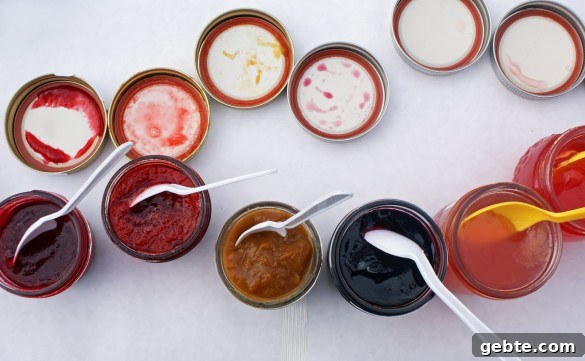
That’s what Pierre called it when we were tasked with choosing one winner from twenty entries at the Bowness Harvest Fair on Saturday morning. A tough job, but somebody had to do it.
We tasted every single entry, some more than once. What surprised me about contests like this is how varied each jar can be. There were peach, crabapple, nanking cherry, raspberry, strawberry, saskatoon berry and blueberry preserves—I’m sure I’ve missed a few. Oddly, there were no plums. There was apple butter and peach butter and even a chutney. One sweet jelly was made with wine to accompany goat cheese, while another thick, slightly runny strawberry jam was flavored with fresh mint and black pepper.
One jar was even labeled for the exact Saturday afternoon it was made. I loved that personal touch and almost wanted it to win for the handwriting alone. The jam inside was thick and pulpy—made by someone who values nanking cherries and works to get as much fruit off the pits as possible. It wasn’t overly sweet and tasted distinctly of fruit. It finished as a runner-up.
The best jam of the day, though, was the pure raspberry. Isn’t there something unbeatable about a simple raspberry conserve? Just raspberries, a squeeze of lemon, sugar and a bit of pectin—though really it’s all about ripe berries. I’m hoping to get the recipe, but I hear the maker (another man—yes, men do make jam) has a generous raspberry thicket behind his house. I’m jealous; I managed to ruin my own patch. As far as I can tell, chard does not make a suitable jam substitute.
Later that Saturday I cooked for a Great Gatsby-themed party—flapper pies, lemon cakes, homemade sausage rolls (a nod to the book), chicken satay with peanut sauce, pesto salmon bites, ham and sweet potato frittata and gruyère gougères. On Sunday, Sue arrived to work on our book and we spent several hours focused on food photography. She came in time for Feast of Fields, which is a fantastic event if you ever get the chance to attend. We also discovered a sure-fire cure for insomnia: a glass of wine in the afternoon, followed by several hours of intense book editing.
Since it was late and I didn’t have a new recipe to share, I revisited a post on jam-making from last August. The jam contest left me inspired by the many homemade varieties, the number of new jam-makers among the entrants, and how approachable jam-making really is if you simply give it a try. There’s hardly anything better than toast spread with your own preserves.
Although people have been preserving fruit in sugar for thousands of years, in recent decades jam-making has gained a reputation for being difficult: hard to set, time-consuming, and technically challenging. That’s not necessarily true. While you can always buy a jar at the store, simmering fruit into jam at home rewards you with fresh flavor and a satisfying result. The basic idea is straightforward: fruit + sugar = jam.
If you’re nervous, take comfort in the fact that loose, slightly runny jam is perfectly acceptable—and delicious. I often prefer a softer set to one that resembles stiff Jell-O. If your batch is very runny, treat it as a fruit syrup that livens up pancakes, waffles, ice cream, biscuits and angel food cake. Own it as intentional.
For a bit of science: the main components of jam and preserves are fruit, sugar, pectin and acid (usually lemon juice). Different fruits contain different amounts of pectin. Under-ripe fruit tends to have more pectin and acid, both of which help the jelling process. High-pectin fruits include apples, currants, oranges and plums; mid-range fruits include blueberries, raspberries, cherries and rhubarb; low-pectin fruits include apricots, peaches and strawberries. Commercial pectin can be used as insurance but isn’t always necessary. Apples (including their seeds) and citrus peels are natural pectin sources; I sometimes add them to the pot or simmer them wrapped in cheesecloth and remove them after cooking, especially when making jelly.
As a guideline, aim for about 1 cup of sugar for every 2–3 cups of chopped fruit. Many classic recipes call for equal parts sugar and fruit, so feel free to increase sweetness if you prefer. Cook fruit and sugar together rather than adding sugar after cooking; sugar helps draw water out of the fruit while preserving its pectin. Add roughly a tablespoon of lemon juice per pound of low-acid fruit—if in doubt, add it.
Bring the mixture to a rolling boil and cook, skimming foam as it appears, until it thickens into a loose jam. Remember it will firm up as it cools. To test for doneness you can use a candy thermometer—the setting point is around 220°F—or place a spoonful on a chilled dish from the freezer. If it wrinkles when you push it gently with your finger and resembles jam, it’s done.
Sugar acts as a preservative in jams and jellies. If you didn’t follow a precise canning formula and are unsure about sealing jars safely, store small quantities in the refrigerator for a week or two for immediate use and freeze the rest—jam freezes very well.
Clear as jam?