

The Apostle’s Creed is one of the most widely known and enduring statements of Christian belief. Spoken in churches around the world for centuries, it provides a concise summary of core Christian convictions and unites believers in a shared confession.
But why do churches still recite the creed today? Is it merely an inherited tradition, or does it serve a deeper spiritual and practical purpose?
This article explains:
- Why churches continue to recite the Apostle’s Creed
- The history and origin of the creed
- What the creed affirms and why it matters
- How it connects modern believers with the early church

- What is the Apostle’s Creed and Its Meaning?
- The First Article
- The Second Article
- The Third Article
- Why the Apostle’s Creed Matters
- The Apostle’s Creed Is a Bold Statement of Faith
- The Apostle’s Creed Unites Christians Worldwide
- The Apostle’s Creed Links Us to the Early Church
- The History of the Apostle’s Creed
- Who wrote the Apostle’s Creed?
- The Apostle’s Creed vs. Nicene Creed
- Denominations that use the Apostle’s Creed
- Is the Apostle’s Creed in the Bible?
- The Words of the Apostle’s Creed
- Why Do We Continue Saying the Apostle’s Creed?
- It Helps Us Remember What We Believe
- It’s a Public Declaration of Faith
- It Connects Us to the Universal Church
What is the Apostle’s Creed and Its Meaning?
The Apostle’s Creed is the oldest widely circulated summary of Christian beliefs. Emerging in the early centuries of the church, it condensed apostolic teaching into a short, memorable confession used for instruction, baptism, and corporate worship.
Reformers such as Martin Luther included the creed in catechisms to teach families and church leaders the essentials of the Christian faith. Luther and others offered brief explanations for each part of the creed to help people understand what they were confessing.
The First Article
I believe in God the Father Almighty, Maker of heaven and earth.
What does this mean?
This line affirms that God is the Creator and Sustainer of all life. It recognizes that every good gift—our bodies, minds, daily provision, and protection—comes from God’s care. The statement calls for gratitude, worship, and obedience, acknowledging that we receive God’s goodness not because of our merit but by divine grace.
The Second Article
I believe in Jesus Christ, His only Son our Lord; who was conceived by the Holy Spirit, born of the Virgin Mary, suffered under Pontius Pilate, was crucified, died and was buried. He descended into hell; the third day He rose again from the dead; He ascended into heaven and is seated at the right hand of God the Father almighty; from there He shall come to judge the living and the dead.
What does this mean?
This article affirms the full divinity and true humanity of Jesus Christ and the saving work He accomplished. It emphasizes the incarnation, suffering, atoning death, burial, resurrection, ascension, and final judgment—central events that secure redemption for believers through Jesus’ life, death, and resurrection.
The Third Article
I believe in the Holy Spirit, the holy Christian Church, the communion of saints, the forgiveness of sins, the resurrection of the body, and the life everlasting. Amen.
What does this mean?
The final section acknowledges the Holy Spirit’s role in calling, enlightening, and preserving believers in true faith. It affirms the reality of the church, the fellowship of believers, God’s forgiveness, bodily resurrection, and eternal life—core hopes that shape Christian identity and practice.
Why the Apostle’s Creed Matters
Reciting the Apostle’s Creed is more than repeating familiar words. It is a deliberate confession that names essential truths about God, Jesus, and the Spirit, and it strengthens both personal conviction and communal unity.
The Apostle’s Creed Is a Bold Statement of Faith
Unlike a private prayer, the creed is a public declaration. When spoken together, it affirms who God is, what Jesus accomplished, the role of the Holy Spirit, and the promise of resurrection and eternal life. This clarity helps congregations affirm core doctrine without ambiguity.
The Apostle’s Creed Unites Christians Worldwide
Because the creed is concise and ancient, it has become a shared confession across denominations and cultures. Reciting it connects local congregations to Christians around the globe and across generations, offering a common language for faith.
The Apostle’s Creed Links Us to the Early Church
Spoken in worship for nearly two thousand years, the creed preserves the teaching of the early church. Its continued use reminds believers that their faith is rooted in a historical community that passed down apostolic truth.
The History of the Apostle’s Creed
The Apostle’s Creed did not originate directly from the apostles nor does it appear as a single text in the Bible. It developed in the early centuries of Christianity—around the second century—as leaders summarized the faith for instruction, baptism, and corporate confession.
Who wrote the Apostle’s Creed?
No single author can be named. The creed emerged gradually through early Christian practice and teaching across regions such as Jerusalem, Alexandria, Rome, and other Mediterranean centers. Its short, memorable format made it suitable for catechesis and public worship.
The Apostle’s Creed vs. Nicene Creed – What’s the Difference?
Several creeds have shaped Christian doctrine. The Apostle’s Creed is the oldest and most concise, used frequently in baptism and general worship. The Nicene Creed (developed in the fourth century) is longer and was written to clarify Christ’s nature in response to theological disputes. The Athanasian Creed, later still, offers a more detailed exposition of the Trinity.
| Creed | Year Developed | Purpose |
|---|---|---|
| Apostle’s Creed | Circa 150 A.D. | Simple summary of Christian beliefs, often used in baptisms and general worship |
| Nicene Creed | 325 A.D. | Developed to address doctrinal controversies about Christ’s nature |
| Athanasian Creed | Circa 500 A.D. | Detailed statement focusing on the Trinity and right belief |
What Christian Denominations Use the Apostle’s Creed?
The Apostle’s Creed is used across a wide range of traditions, including Protestant (Lutheran, Anglican, Methodist, Baptist and others), Roman Catholic, and many Orthodox and non-denominational congregations. While not every congregation recites it weekly, its teachings are widely affirmed.
Is the Apostle’s Creed in the Bible?
The creed itself is not a biblical text, but its statements are rooted in Scripture. Lines of the creed reflect biblical teachings about creation, Christ’s death and resurrection, the work of the Spirit, forgiveness, resurrection, and eternal life. In that way, the creed functions as a concise summary of biblical doctrine.
The Words of the Apostle’s Creed
Below is the traditional wording commonly used in many churches:
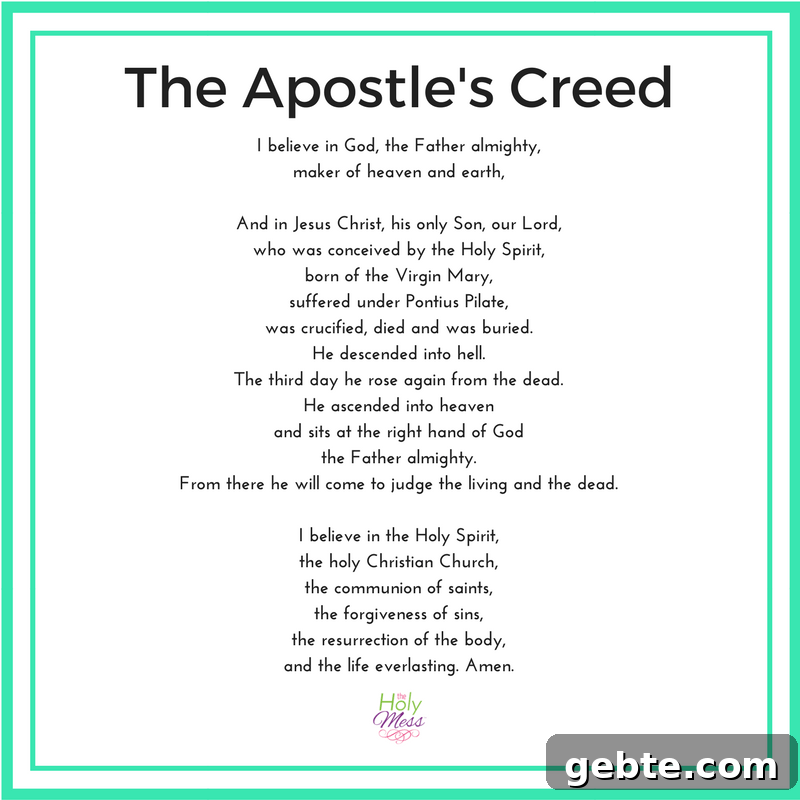
I believe in God, the Father almighty, maker of heaven and earth,
And in Jesus Christ, his only Son, our Lord, who was conceived by the Holy Spirit, born of the Virgin Mary, suffered under Pontius Pilate, was crucified, died and was buried. He descended into hell. The third day he rose again from the dead. He ascended into heaven and sits at the right hand of God the Father almighty. From there he will come to judge the living and the dead.
I believe in the Holy Spirit, the holy Christian Church, the communion of saints, the forgiveness of sins, the resurrection of the body, and the life everlasting. Amen.
Why Do We Continue Saying the Apostle’s Creed?
Reciting the Apostle’s Creed remains a meaningful practice for several practical and spiritual reasons.
It Helps Us Remember What We Believe
Because the creed is concise and structured, it serves as a ready answer to the question, “What do you believe?” Memorizing or regularly hearing the creed helps Christians retain the essentials of the faith.
It’s a Public Declaration of Faith
When a congregation speaks the creed together, it acts as a communal confession. The shared response reinforces unity and reminds worshipers that faith is both personal and public.
It Connects Us to the Universal Church
Reciting the Apostle’s Creed links present-day believers to the early church, to fellow Christians worldwide, and to future generations who will inherit and pass on the same confession. The creed is a bridge across time, reminding believers that their faith participates in a continuous, global story.
Does your church recite the Apostle’s Creed regularly? Consider how this short, ancient confession might shape your understanding and expression of faith.
Suggested related topics to explore:
- 20 Bible verses for personal growth
- Prayers for spiritual encouragement
- What is Advent?
- What is Lent?
- How to know if you are a Christian
- Scripture passages that explain God’s attributes
- Bible verses about forgiveness